
What root causes the ass to move, and who is the clown who makes it all happen?
Pipo equation
- The statement is about: leadership, guidance, motivation & performance.
- This can be about: project manager, inspiration & team/ tools.
- It could also be about parenting and bedtime stories, resulting in “a quiet evening and time together.”
The primary audience for this story is project managers. But whoever reads it, in all fairness, it only works if all factors are aligned.
Here’s a list of equations, formulas, and models. Consider them useful per situation or target group.
- As a carpenter, it’s useful to know Pythagoras, because it tells you how long a piece of wood must be to bridge the ends of something with straight angles.
- If you’re going to build atomic bombs with your project, you also need to know Einstein’s E=MC2 thing.
- Archimedes is important for shipbuilding.
- Bartjens says that something must be correct if the reasoning is thorough enough.
- The Pipo equation is my contribution to humanity.
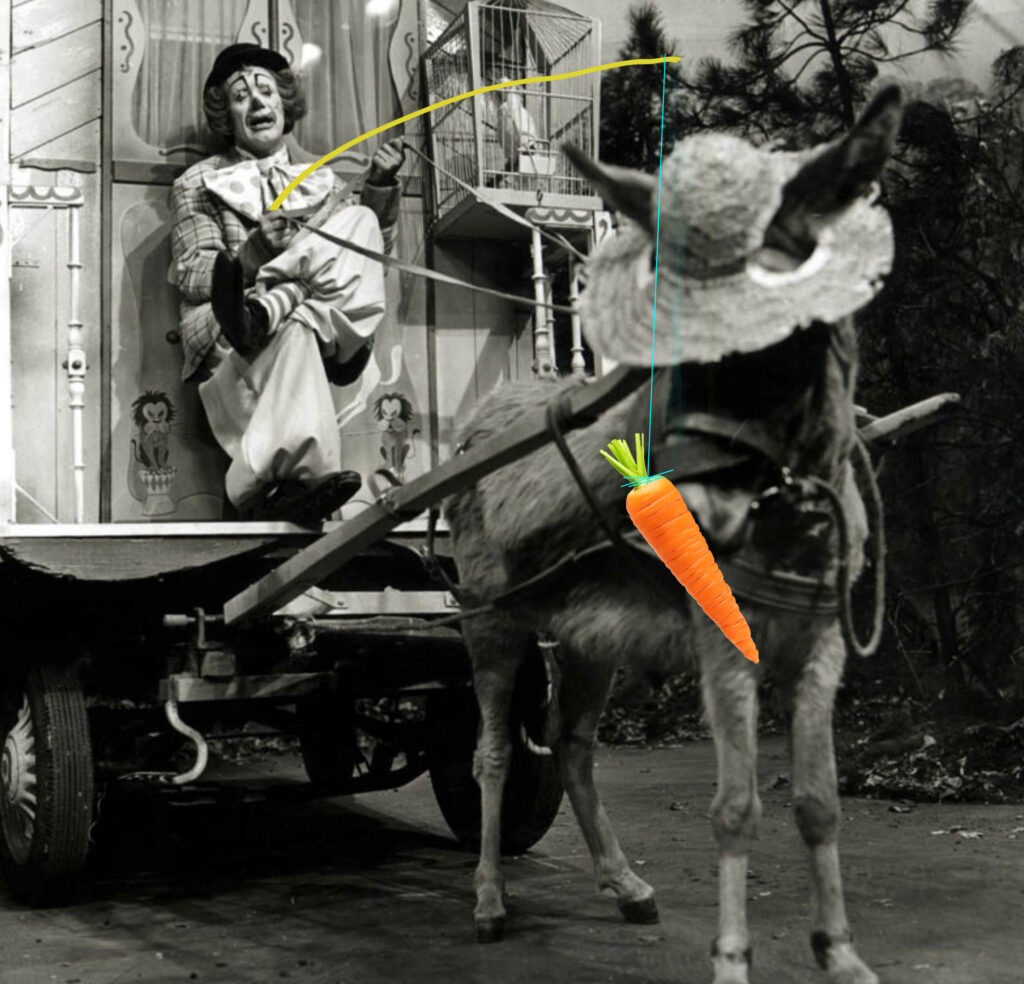
Pipo equation
| Topic | Role |
| Pipo | The clown who makes sure the circus comes to you |
| Ass (donkey) | Say IA and create traction |
| Wagon | A vehicle with "something to sit on", something to move things around in, and something to protect you from the elements. |
| Fishing rod | Transfer the plan in the clown's head to the ass. The ass or donkey knows which direction to pull, and the rod also ensures that the donkey can reach the carrot only at the desired moment. Meanwhile, the prospect of a reward is merely an illusion. |
| Root | Motivation. Inspiration! People are motivated by a combination of internal drivers (intrinsic) such as personal growth, passion, and purpose, and external factors (extrinsic) such as salary, recognition, and rewards. Core motivational needs are autonomy (freedom), competence (ability), and relatedness. Pleasure, curiosity, and fear of loss also stimulate behavior. Napoleon once defended the awarding of medals (motivation) with the words: "You call these trinkets; well, they are trinkets with which men are led... Do you think you can reason men into fighting? Never." |
| Parrot | Players who ride along and provide commentary but otherwise contribute little energy or knowledge. If the parrot becomes a nuisance, as a clown, you always have the option of throwing a cloth over the cage. |
| Circus | Way (movable infrastructure) to make people happy and when that's done, you move on to the next village/project |
| Road | Something others have taken care of and that Pipo, donkey, and cart can use. Without this road with all its bends, you might be able to get from A to B in a straight line, but then you'd have to go through everything. The road offers the least resistance. |
| Audience | You have a feeling it will show up, but you only really know when you're in the ring and start performing your trick |
| Pleasure | The goal. |
What root causes the ass to move, and who is the clown who makes it all happen?
Is this proper English?
When you translate it to Dutch, it's no way funny...
- Let’s break down the grammar of that statement: “What root causes the ass to move, and who is the clown who makes it all happen?”
Here’s an analysis:
- “What root causes…”: This part is grammatically correct. “Root” is used here as a noun, meaning the fundamental origin or cause, and “causes” is the verb.
- “…the ass to move…”: This is also grammatically correct. “Ass” is the object of the verb “causes,” and “to move” is an infinitive phrase acting as a complement describing the action.
- “…and who is the clown…”: Correct. “Who” is a relative pronoun, and the clause functions as an interrogative asking about identity.
- “…who makes it all happen?”: Correct. Again, “who” is a relative pronoun linking to “clown,” and the clause describes the action of the clown.
Overall, the grammar is correct.
However, there are stylistic and semantic considerations:
- “the ass”: While grammatically correct, “ass” is a colloquial and often vulgar term for a donkey or, more commonly, a person’s buttocks. In this context, it’s clearly being used metaphorically to refer to some kind of inert or stubborn entity that needs to be moved. The choice of word itself carries a certain tone.
- “the clown”: This is also a metaphorical use, implying someone foolish, ridiculous, or perhaps manipulative who is orchestrating events.
So, while the sentence is grammatically sound, its impact and meaning rely heavily on the metaphorical use of “ass” and “clown,” which gives it a very informal, somewhat aggressive, and perhaps even humorous tone, depending on the context.
Tagged Motivation, Project management, Roleplay